Featured Bar Listings on Local Apps: Is the ROI Real?

Short answer
It's 4:30 on a Tuesday. The barstools are empty, your bartender is restocking the well, and you're staring at an email from a local app offering you a featured placement for $99 a month. The pitch sounds good, more visibility, more revenue. But you've been around long enough to know that "more visibility" and "more revenue" are not the same sentence.
So should a bar pay for a featured listing on a local app? That's the question this article answers honestly. We'll walk through the math, the mechanics, the tracking setup, and the decision framework so you can answer it for your specific situation before spending a dollar.
## Free vs. paid listings: should a bar pay for a featured listing on a local app?
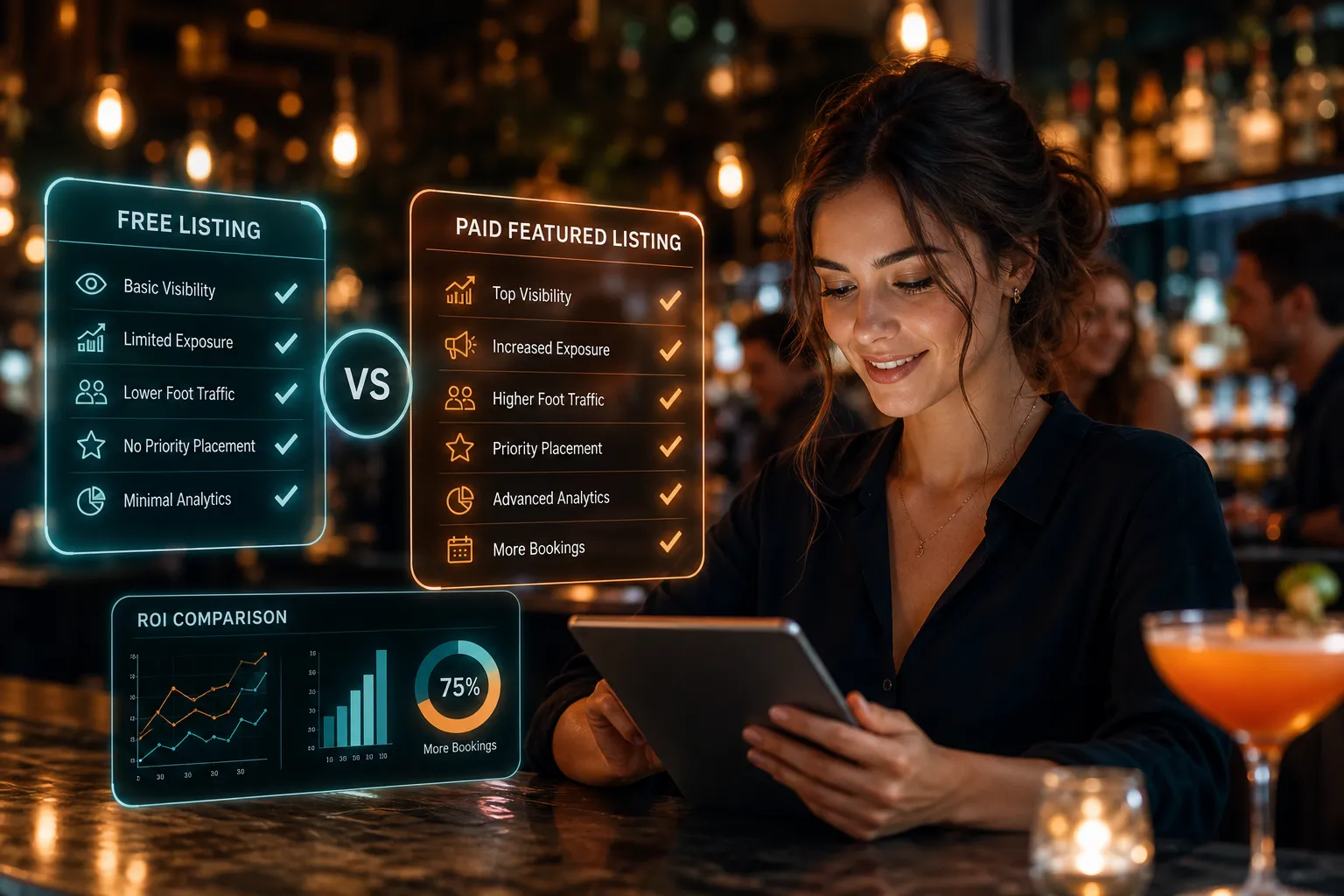
A free venue listing gets you in the door. You're on the platform, your name and address are searchable, and deal-seekers can technically find you. The limitation is that "technically findable" is doing a lot of heavy lifting in that sentence. On a general-purpose directory, you're competing with every other bar in the same category with identical exposure. Nobody's pushing your Wednesday wing special to a user who just opened the app on a Tuesday night.
A featured or promoted listing changes the mechanics of discovery. You get priority positioning in search results, visual differentiation like badges or larger cards, and on niche platforms, inclusion in deal alert notifications. On a platform like Happy Hour Flower, that means your specials appear at the top of a live map for users who are actively looking for somewhere to go right now, not users who might stumble across you while searching for pizza.
The variable that matters most isn't traffic volume, it's audience alignment. A featured placement on a national review platform with millions of users is worth less to a neighborhood bar than a featured slot on a local platform where every active user is a resident or visitor searching for drink specials tonight. Reach and relevance are different things. Relevance is what drives people through your door.
## What featured listings actually cost (and how you get billed)
Most local and niche discovery apps use flat-fee subscriptions rather than cost-per-click or cost-per-thousand-impressions billing. That's a friendlier model for small venues because your maximum spend is predictable. You know going in that you're committing $75 or $99 a month, not watching a budget meter tick up based on traffic you can't control.
Pricing patterns across the local app advertising landscape break down roughly like this:
- Local or niche directories: Flat monthly fees typically land between $25 and $150. Annual plans often come with a discount, pulling the effective monthly cost below the month-to-month rate.
- Short-duration boosts: Some platforms offer 30-day tests for around $30, or a week-long push for roughly $75, useful when you want to try paid local discovery without a full subscription commitment.
- Larger national platforms: The floor is usually higher, often starting around $150 per month, with typical small-business spend running $300 to $1,500 per month for sustained visibility.
Before signing anything, ask four questions: What exactly counts as "featured" placement, top of list, sidebar ad, push notification, or all three? What data does the platform report, and how often? What are the cancellation terms? And can the platform show you how many of their active users are in your geography? That last one is the tell. A platform that can't answer it doesn't know its own audience well enough for you to trust the placement.
## Benchmarks: what to expect if a bar pays for a featured listing on a local app
You don't need perfect data to run a back-of-napkin estimate. You just need reasonable proxies and an honest look at your own numbers. Industry estimates put local services ads at roughly 4.7% [click-through rate](https://cxl.com/guides/click-through-rate/benchmarks/), and hospitality and travel conversion benchmarks from comparable search channels land between 5.75% and 7.52% (per WordStream's industry benchmarks). Run those together and here's what the math looks like: 500 monthly impressions at a 4.7% CTR gives you about 23 clicks. At a 6% conversion to visit, that's one to two new customers from the listing in a month.
That sounds modest. But the benchmark cases show what happens when featured placement combines with a strong offer and clean tracking. Maverick Distillery ran Yelp Ads and documented 2,693 attributed store visits over six months, with 76% of November visits happening within one day of ad exposure. Wild Moose Saloon ran a three-week paid digital promotion and saw a 210% increase in event attendance with a 25.8x return on ad spend. The Crafty Corner added a promoted listing to its marketing mix and tracked a 40% revenue increase over six months. These aren't guaranteed outcomes, but they illustrate what intent-matched promotion can do when the offer is real and the tracking is in place.
The formula is straightforward: monthly listing cost divided by new attributed customers equals cost per acquisition. At $99 a month and five new customers, you're at $19.80 per customer. If your average tab is $35 and those customers return twice in the quarter, the math is positive. If your average tab is $12 and they never come back, it isn't. Run your own numbers before you run anyone else's.
## The tracking setup that makes your ROI measurable
Most featured listing platforms report impressions, clicks, and CTR. Some add phone clicks and direction requests. What almost none of them provide automatically is offline visit data or in-venue spend. That's the gap that causes bar owners to either overclaim ("business is up, must be the listing!") or underclaim ("I didn't see anything from it") when the real answer requires connecting the full funnel.
Here's the minimal tracking setup you need:
### UTM links
Add [UTM parameters](https://web.utm.io/) to any clickable link in your listing: source set to the platform name, medium set to "featured_listing," and campaign set to the specific promotion. This ties digital traffic directly back to the placement.
### Tracked phone numbers
If the platform includes a phone number field, route it through a tracked number so calls tie back to the listing rather than disappearing into your general call volume.
### Staff tally
Brief your staff to ask one question at the point of service: "How'd you hear about us?" A dated tally sheet costs nothing and tells you which customers came from the listing, no software required.
Track four numbers monthly: impressions, clicks, attributed visits (combining digital and offline signals), and revenue from those visits. Ninety days of that data gives you a real picture. Thirty days gives you a signal. Less than thirty gives you noise. Set your measurement window before you start and stick to it, changing the goalposts mid-test is how good data becomes a bad decision.
## When a featured listing pays off (and when to skip it)
A promoted listing tends to outperform in specific conditions: your free listing already gets organic views but doesn't convert them to visits; you run consistent specials that deal-seekers are actively searching for; and your slow hours are genuinely slow enough that even modest traffic lift changes your weekly numbers. Bars in active downtown markets running regular happy hours with real value are well-positioned to see returns. Bars with inconsistent specials or hours that don't match deal-seeker behavior are not.
As part of your broader venue marketing for bars, it's worth knowing the lower-cost alternatives before you commit to paid placement:
- [Google Business Profile (free):](https://www.brightlocal.com/research/google-my-business-insights-study/) High intent, strong for "bar near me" searches, and consistently one of the most effective free local visibility tools available
- Email to your existing list: Industry benchmarks estimate $36 to $42 returned per $1 spent; your current customers are your cheapest acquisition
- Geo-targeted social ads: More budget control than a flat listing fee and effective when tightly local, but they require consistent creative effort
- [Free event listings:](https://birdeye.com/blog/free-advertising-sites/) Zero cost, with traffic spikes around specific nights, ideal for trivia nights, live music, or themed events
Three questions will tell you which direction to go. Does your existing free listing get impressions? Do those impressions convert to visits you can trace? Is your average customer lifetime value high enough to justify a $50 to $150 monthly acquisition cost? If your answer to the first question is "I have no idea," start with free tracking before paying for more visibility. You can't optimize what you haven't measured.
## Running a 30-day test without betting the bar
Two weeks before your paid listing goes live, document your baseline: actual head counts during slow hours, POS transaction data by time slot, and any existing digital traffic from your free listing. Without a baseline, your test results are just a feeling that things got busier, and feelings don't tell you whether to renew.
Before activating the featured placement, set up your UTM links, add a tracked phone number if possible, brief your staff on the "how'd you hear about us?" question, and define the single KPI that determines success for your bar. Keep it concrete: five new customers per week during happy hour, or eight direction requests per week from the listing. Pick one platform, one time window, and don't change anything else in your marketing during the test. Adding an Instagram campaign at the same time means you'll never know which channel moved the needle.
At 30 days, read the results honestly. If you hit your KPI and cost-per-customer is below your average first-visit revenue, renew and consider scaling. If you're close but not there, assess whether the offer or listing content was the weak point and test a revision. If you saw no measurable lift after a full month, that's useful data: either the platform's audience doesn't match your customer, or your specials need stronger framing. You haven't lost more than a month's fee, and you walk away knowing something real.
## The bottom line: should a bar pay for a featured listing on a local app?
Paying for a featured listing on a local app isn't a yes-or-no decision. It's a math problem. You have the inputs, run it for your bar. The venues that see real returns from nightlife app promotion don't gamble on visibility. They test it, track it, and hold it against a clear [cost-per-customer target](https://happyhourflower.com/financial-overview).
If you're running regular specials and looking for a low-risk first test of sponsored listing for venues, [Happy Hour Flower's premium featured placement](https://happyhourflower.com/venue-ads) is built for exactly this scenario. Your specials go in front of local deal-seekers who are already on the map looking for somewhere to go tonight, not users passively browsing a national directory. The audience is local, the intent is high, and the [pricing is sized for independent venues](https://happyhourflower.com/site/pricing/venues) rather than chain marketing budgets.
Related articles

Happy Hour Promotion Metrics: What to Track and Why
Track impressions, listing views, saves, directions, clicks, calls, and redemptions to see whether a happy hour promotion creates real visit intent.

Where to Find Lunch Specials in Greenville, SC
Find Greenville lunch specials worth checking today, compare deal types, and use a quick method to confirm prices, hours, and availability before lunch.

Google Maps vs. Yelp for Finding Happy Hour Deals
Compare Google Maps and Yelp for happy hour: what each can tell you, what they cannot, and how to verify today’s deal before you go.